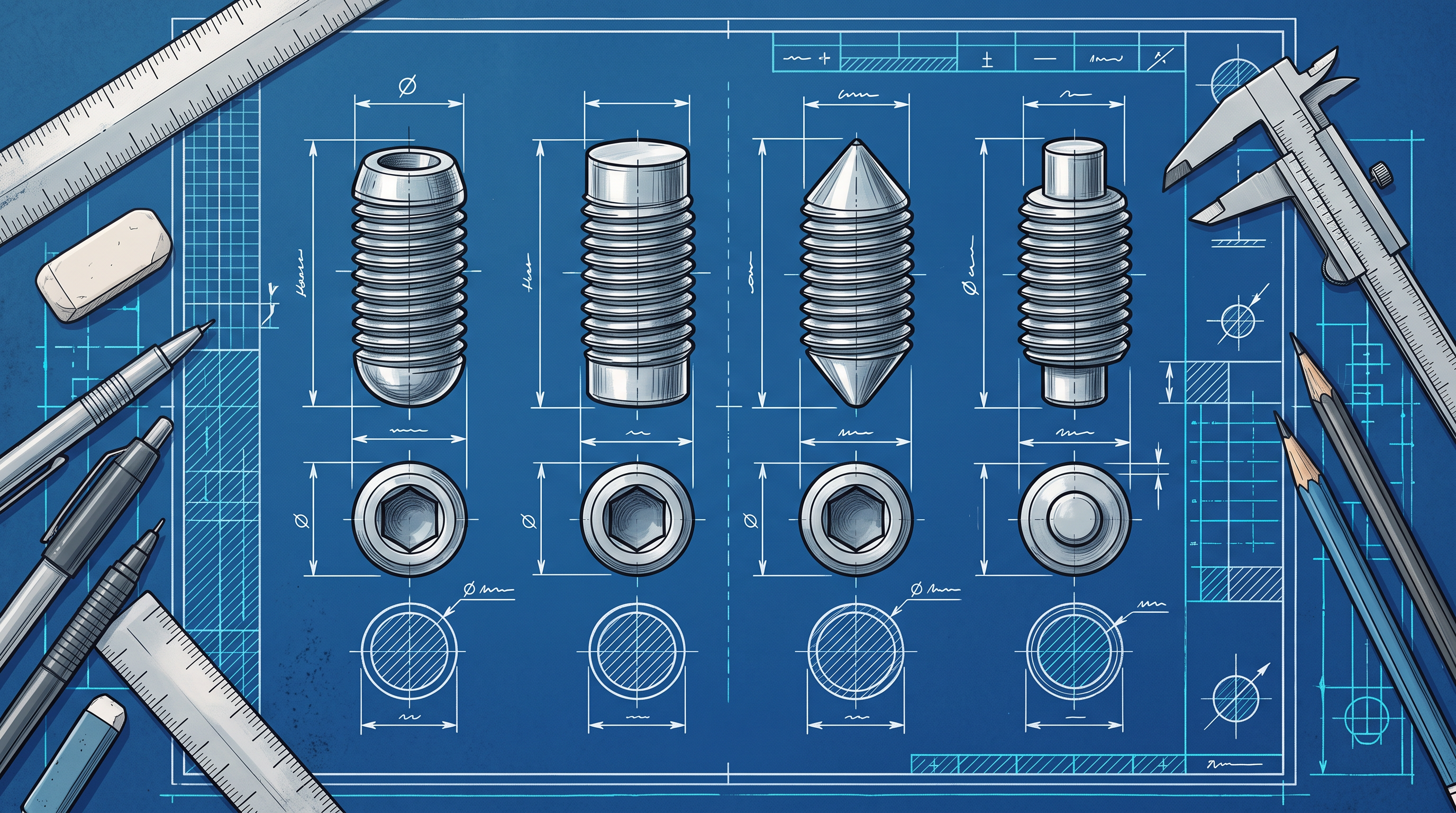
Socket set screws are headless threaded fasteners driven by an internal hexagonal socket, designed to secure components such as pulleys, gears, or collars against a shaft or mating surface. In industrial procurement across Thailand and Southeast Asia, engineering drawings and procurement inquiries frequently cite international standards to communicate geometry and tolerances. Using accurate socket set screw standard references din iso ensures that drive geometry, thread pitch, and point features align properly with assembly requirements.
Understanding Socket Set Screw Standard References: DIN and ISO
Engineering drawings and legacy bills of materials frequently reference national and international standards. For set screws, the most common standard systems encountered by procurement teams are DIN (Deutsches Institut für Normung) and ISO (International Organization for Standardization).
PENLY TH CO., LTD. advises that DIN, ISO, GB, and ASME references are not interchangeable by name alone. The exact standard edition and the relevant dimensions should always be checked before a substitution is proposed. Furthermore, a dimensional standard defines physical form and drive tolerances; it does not by itself fix the material, property class, or coating.
Key Socket Set Screw Point Styles and Standard Distinctions
A set screw functions primarily through compressive holding force or mechanical penetration at its tip. Selecting the proper point style depends on the hardness of the mating component and whether surface penetration or frequent re-adjustment is intended.
- Flat Point: Features a flat contact tip designed to bear against ground shaft flats or thin-walled tubing without piercing the mating material.
- Cone Point: Features a sharp, conical point intended to seat into a matching drilled detent or softer metal shaft, providing a mechanical lock against axial and torsional loads.
- Dog Point (Full or Half Dog): Features an unthreaded cylindrical projection that fits into an alignment hole or shaft keyway, serving as a locating pin or retaining guide without relying purely on friction.
- Cup Point: A widely used general-purpose style, featuring a cupped contact edge that bites into the shaft surface to provide resistance against dynamic vibration and slippage.
Specifying Material Grades and Surface Treatments
Because socket set screws lack a conventional head and withstand concentrated internal torsional force during installation, their material requirements must be carefully specified in technical inquiries.
Carbon and Alloy Steels
Alloy and carbon steel set screws are evaluated by hardness and tensile requirements to withstand wrenching torque and provide sufficient compressive grip. Depending on atmospheric exposure, carbon and alloy steel fasteners can be specified with standard black oxide or protective zinc-plated coatings.
Stainless Steel Grades
Product Capabilities and Boundaries
PENLY TH CO., LTD. manufactures a broad range of fastener types and supports both standard forms and custom production requirements. The PENLY TH product catalogue lists 75 product families in nine categories: bolts and threaded rods (16), nuts (24), machine screws (8), set screws (4), self-drilling screws (5), tapping screws (4), washers (7), retaining rings (3), and anchors and fixings (4).
When reviewing socket set screws and preparing enquiries, buyers should note several operational boundaries:
- Catalogue Dimension Tables: The reference dimension tables on the PENLY TH website come from a customer-provided catalogue. They help describe requirements but are not verified stock or a conformity declaration; final dimensions, material, and supply details require confirmation.
- Engineering and Load Design: The PENLY TH catalogue does not provide load ratings or installation design. Buyers are responsible for validating holding power and mechanical load suitability for their specific applications.
- Enquiry Review: Material and grade are specified in the buyer's enquiry, and dimensions and finish are reviewed against the buyer's requirements.
Buyer Evaluation Checklist for Set Screw RFQs
To ensure prompt and accurate technical reviews, procurement teams should confirm the following details before submitting a set screw RFQ:
- Standard Reference and Edition: Note the explicit standard designation (e.g., ISO or DIN reference) along with nominal diameter, thread pitch, and total nominal length.
- Point Style: Explicitly state the tip form (flat, cone, dog, or cup point) rather than relying on generic descriptions.
- Material & Grade: Specify the exact alloy grade or property class instead of general material labels.
- Protective Finish: Indicate surface treatment requirements, such as plain black oxide or zinc plating.
- Custom Requirements: For non-standard dimensions, custom dog-point lengths, or specialized tolerances, provide drawing details including dimensions, tolerances, units, and drawing revisions for feasibility review.
Next Steps
Buyers can build one inquiry list on the PENLY TH website for both standard parts and custom requirements, and can contact PENLY TH sales through its Thailand WhatsApp and LINE accounts.