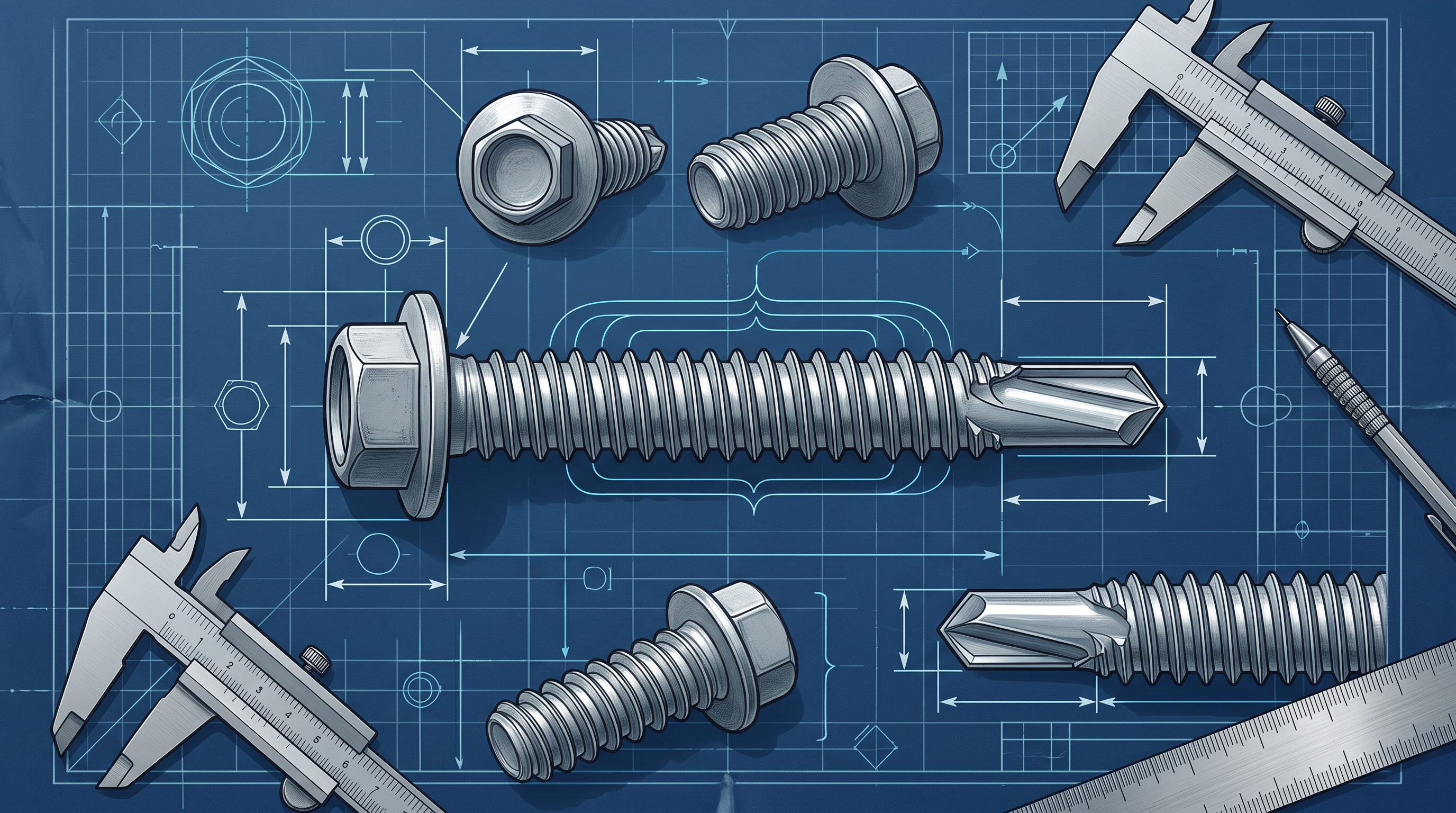
Procuring fasteners for light-gauge steel framing, roofing assemblies, or industrial sheet metal requires rigorous technical specification to prevent mechanical failure during installation. For industrial buyers, fastener distributors, and OEM procurement teams across Southeast Asia, an incomplete request for quotation (RFQ) frequently causes quotation delays or misalignment in production tooling. Utilizing a comprehensive self drilling screw specification checklist ensures that manufacturers and suppliers evaluate technical feasibility accurately before manufacturing commences.
Prerequisites Before Preparing an RFQ
Prior to submitting an inquiry for custom or standard self-drilling screws, engineering and procurement teams should assemble core joint parameters. Self-drilling screws drill, tap, and clamp in a single continuous drive operation, which means the mechanical demands on the fastener vary according to the substrate configuration:
- Total Substrate Thickness: The combined thickness of all metal plies being joined, including any intermediate timber, composite, or insulating materials.
- Substrate Hardness and Material: The steel grade and tensile strength of the structural support (such as cold-formed purlins or hot-rolled structural steel).
- Environmental Exposure: Atmospheric conditions, industrial humidity, marine environments, or chemical exposure governing corrosion requirements.
- Dimensional Reference Standards: Regional or international dimensional standards (such as ISO, DIN, GB/T, JIS, or ASME/ANSI).
Ordered Practical Steps: The Self Drilling Screw Specification Checklist
Step 1: Define Drill Point Size and Total Drilling Capacity
- Drilling Capacity: The maximum thickness of steel the point can pierce without burning out or stalling.
- Flute Length: The unthreaded drill flute length must exceed the total combined thickness of the joined layers to ensure drilling debris clears properly before the threads engage the metal.
- Pilot Section: Ensuring the drill tip exits the lower metal ply before thread tapping begins to avoid jacking or separating the assembled sheets.
Step 2: Establish Head Style and Drive Recess
The chosen head geometry balances bearing area, aesthetic requirements, and tool engagement clearance:
- Hex Washer Head (HWH): Standard for metal building systems and structural framing; specifies whether an integrated flange or an assembled sealing washer (such as EPDM) is required.
- Pan, Truss, or Wafer Head: Specified for low-profile architectural cladding, ductwork, or bracket attachments.
- Drive Type: Hexagonal drive, Phillips, Torx (six-lobe), or square recess, defining tool retention and cam-out resistance under high installation torque.
Step 3: State Dimensions, Tolerances, and Reference Standards
Fastener reference standards across different international bodies are not interchangeable by designation alone. Dimensional tolerances, thread profiles, and head dimensions often vary across standards:
- Nominal Length: Total fastener length, measured from under the head to the tip for protruding heads, or overall length for countersunk fasteners.
- Standard Edition: The exact standard edition must be noted (for example, checking specific editions of DIN, ISO, GB/T, or ASME) rather than assuming equal nomenclature guarantees identical dimensions.
Step 4: Specify Material Grade and Metallurgical Requirements
A dimensional reference standard does not by itself fix material grade, core hardness, or surface hardness. The RFQ should clarify:
- Carbon Steel: Case-hardened carbon steel (such as cold-heading grades) heat-treated to achieve surface hardness capable of penetrating specified structural steels.
- Hardness Parameters: Required case depth along with surface and core hardness ranges to prevent brittle failure or thread stripping under torque.
Step 5: Detail Surface Treatment and Hydrogen Embrittlement Relief
Corrosion protection should be documented alongside metallurgical baking requirements:
- Electroplated Zinc: Specifying clear or yellow passivation along with target plating thickness in microns.
- Multi-Layer / Organic Coatings: Zinc-flake, Ruspert, or ceramic barrier coatings for higher salt-spray resistance in outdoor or industrial atmospheres.
- Hydrogen Embrittlement Relief: For case-hardened carbon steel fasteners subjected to electroplating, baking protocols must be specified to relieve hydrogen embrittlement.
Step 6: Packaging, Quantity, and Inspection Criteria
Clear delivery and inspection specifications prevent commercial friction upon receipt:
- Packaging Requirements: Bulk industrial carton packing, small inner boxed packaging, branded labelling, or palletization requirements.
- Inspection Protocols: Acceptance Quality Limit (AQL) levels, dimensional sampling reports, or drilling time test procedures.
Custom RFQ Checklist Summary
| Specification Field | Key Information to Provide | Why It Matters |
|---|---|---|
| Drill Point & Capacity | Prevents point burnout, flute clogging, or screw shearing before thread engagement | |
| Head & Drive Style | Hex washer, countersunk, pan, wafer; hex, Phillips, Torx | Ensures correct clamping load, head clearance, and tool engagement during assembly |
| Nominal Dimensions | Thread diameter, nominal length, thread pitch, reference standard | Ensures dimensional fit; prevents incorrect standard substitution assumptions |
| Material Metallurgy | Provides sufficient point hardness to pierce the substrate without brittle shank failure | |
| Surface Finish | Zinc plating thickness (µm), organic coating, de-embrittlement baking | Establishes required corrosion protection and guards against hydrogen embrittlement |
| Commercial Scope | Order quantity, drawing revisions, packaging units, inspection level | Allows manufacturers to assess tooling setup, sampling feasibility, and testing needs |
Common Pitfalls in Fastener Inquiries
- Assuming Standard Interchangeability: Treating DIN, ISO, GB, and ASME standards as interchangeable by name alone without cross-referencing specific dimensional tables and tolerances.
- Omitting Total Substrate Thickness: Specifying nominal length without verifying that the unthreaded drill flute clears the entire joined thickness before thread engagement.
- Indefinite Coating Specifications: Stating "zinc plated" without defining coating thickness, chromate type, or required salt-spray test hours.
Evaluating Custom Capabilities with PENLY TH CO., LTD.
PENLY TH CO., LTD. manufactures a broad range of fastener types and supports both standard forms and custom production requirements. The PENLY TH catalogue includes 75 product families in nine categories: bolts and threaded rods (16), nuts (24), machine screws (8), set screws (4), self-drilling screws (5), tapping screws (4), washers (7), retaining rings (3), and anchors and fixings (4).
For drawing-based custom fastener inquiries, buyers can share technical drawings detailing dimensions, tolerances, units, and drawing revisions alongside specific requirements for material, property class, finish, quantity, and packaging. PENLY TH reviews feasibility, samples, tooling, and inspection before specifications, quotations, and delivery arrangements are agreed upon. Alternatively, buyers can start from a catalogue product family and describe what parameters need to change.
Because dimensional references such as DIN, ISO, GB/T, JIS, and ASME/ANSI do not by itself fix material, property class, or coating, PENLY TH product pages leave material, grade, and finish to be specified in the buyer's inquiry. The reference dimension tables on the website derive from a customer-provided catalogue to help describe requirements rather than represent verified stock or conformity declarations; final dimensions, materials, and supply details require confirmation.
Buyers can build a single inquiry list on the PENLY TH website for both standard catalogue parts and custom requirements, contacting PENLY TH sales through its Thailand WhatsApp and LINE accounts.