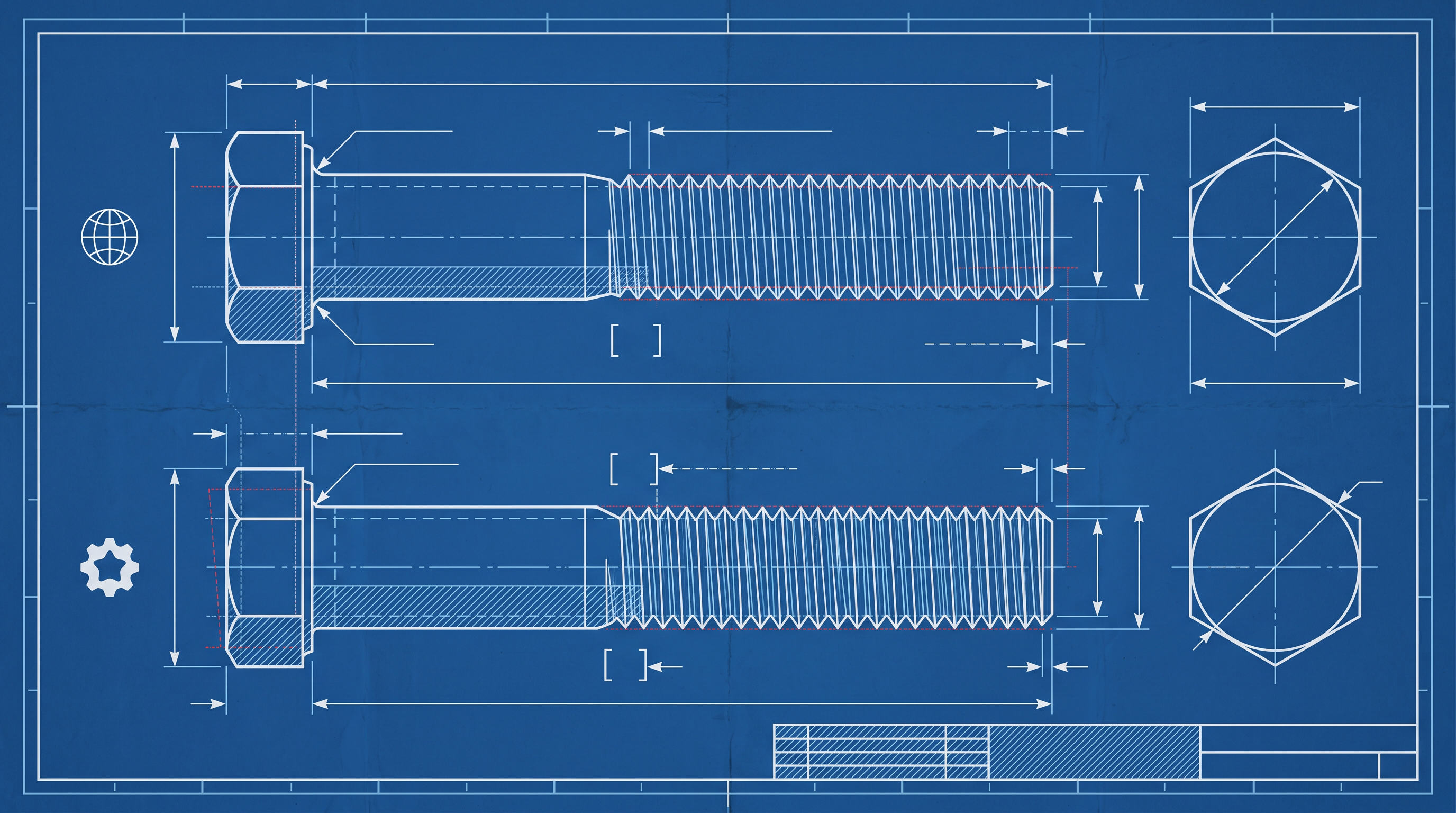
In global mechanical engineering and fastener procurement, cross-referencing international and national standards is a regular requirement. For fully threaded hexagon head screws (often termed full-thread hex bolts), two specifications frequently appear in engineering drawings and supply bills: ISO 4017 and China's national standard GB/T 5783. While both govern metric full-thread hex bolts, substituting one standard for another requires careful verification rather than assumed interchangeability.
ISO 4017 (such as ISO 4017:2022) is maintained by the International Organization for Standardization and specifies the characteristics of hexagon head screws with metric coarse threads from M1.6 up to M64, with product grades A and B. It is widely adopted across Europe, Southeast Asia, and multinational OEM platforms.
GB/T 5783 (referenced in current manufacturing editions up to GB/T 5783-2025) is the Chinese national standard for full-thread hexagon head bolts with product grades A and B. Because China is a major hub for fastener manufacturing and equipment design, machinery designed for or imported into Southeast Asian assembly plants frequently specifies GB/T standards on part drawings.
Comparison Criteria for Full-Thread Hex Bolts
1. Width Across Flats (s-dimension)
One of the primary historical concerns when comparing ISO standards with legacy national standards (such as older DIN specifications) was the width across flats (s) for diameters like M10, M12, M14, and M22. GB/T 5783 was developed in harmonization with ISO metric fastener standards. As a result, both ISO 4017 and GB/T 5783 align on nominal width-across-flats values across the primary metric ranges (for example, s = 16 mm for M10, s = 18 mm for M12, and s = 21 mm for M14). However, engineers must review nominal values alongside allowable tolerance bands on actual inspection drawings.
2. Head Height (k-dimension) and Underhead Fillets
Head height (k) and transition fillet radii under the bolt head govern wrench engagement, clearance within counterbores, and stress concentration under tensile preloads. While nominal head heights between modern ISO 4017 and GB/T 5783 are essentially parallel across standard diameters, tolerance classes (Product Grade A for smaller diameters/shorter lengths and Grade B for larger sizes) define upper and lower limits. Verification against the specific standard edition is necessary when fitting fasteners into tight recessed pockets.
3. Thread Form, Pitch, and Full-Thread Runout
Both standards apply standard general-purpose metric screw threads with 6g tolerance classes. Both specifications define "full-thread" fasteners, meaning threading extends to near the underhead transition fillet, subject to standard thread runout allowances (a). For clamped joints requiring minimum grip length or assemblies without clearance washers, thread runout distances must be verified to prevent joint bottoming.
4. Material, Property Class, and Surface Coatings
A crucial rule in fastener procurement: a dimensional standard does not by itself fix the material, property class, or coating. ISO 4017 and GB/T 5783 govern physical dimensions and product grades. Mechanical properties must be specified independently using applicable material standards:
- Carbon and alloy steels: Property classes such as 8.8, 10.9, or 12.9 (governed by ISO 898-1 or GB/T 3098.1).
- Stainless steels: Austenitic grades such as A2-70 (SUS304 equivalent) or A4-70 (SUS316 equivalent) (governed by ISO 3506-1 or GB/T 3098.6).
- Surface finishes: Plain/black oxide, electroplated zinc, hot-dip galvanizing, or zinc flake coatings, which require their own coating thickness and salt spray criteria.
Practical Trade-Offs and Cross-Referencing Rules
- Tooling and Clearance: Because both modern standards share metric width-across-flats conventions, field assembly tooling (wrenches and sockets) is generally compatible across identical nominal sizes.
- Standard Edition Impact: Engineering drawings often specify a base number without a year, while manufacturers may reference specific editions (such as ISO 4017:2022 or GB/T 5783-2025). The applicable edition must be identified to ensure tolerance bands have not shifted.
- Documentation Requirements: While a physical GB/T 5783 bolt may match the dimensional envelope of an ISO 4017 bolt, critical engineering contracts may require test certificates referencing the exact standard cited in the contract.
Checklist for Fastener RFQs and Technical Inquiries
When compiling an RFQ or cross-standard inquiry for regional distribution or manufacturing in Thailand and Southeast Asia, include complete technical parameters:
- Standard Reference and Edition: Explicitly state ISO 4017 or GB/T 5783, along with acceptable alternative equivalents.
- Property Class or Material Grade: e.g., Class 8.8, Class 10.9, or Stainless Steel A2-70.
- Surface Treatment: e.g., Clear zinc plated, hot-dip galvanized, or plain oiled.
- Inspection and Certification: Specify required mill test reports or dimensional verification documentation prior to production or delivery.
Working with PENLY TH CO., LTD.
PENLY TH CO., LTD. manufactures a broad range of fastener types and supports both standard forms and custom production requirements. The PENLY TH product catalogue lists 75 product families in nine categories, including 16 families within bolts and threaded rods. Each catalogue product family lists selection references across ISO, DIN, GB/T, JIS, and ASME/ANSI standards—such as referencing ISO 4017:2022 and GB/T 5783-2025 for fully threaded hexagon head bolts.
Because reference dimension tables serve as descriptions rather than verified stock declarations, PENLY TH reviews material, property class, dimensions, and finishes against your specific inquiry requirements. Industrial buyers can build a single inquiry list on the PENLY TH website for standard and custom parts, or connect directly with PENLY TH sales via Thailand WhatsApp and LINE accounts.