Standard industrial fasteners conform to published dimensional norms, allowing volume availability across common mechanical assemblies. However, specialized automotive subassemblies, industrial machinery, structural connections, and bespoke equipment housings frequently require non-standard geometries, altered thread profiles, non-catalog dimensions, or specialized alloys. In such cases, procurement teams and design engineers turn to custom fasteners.
Developing a custom fastener moves procurement beyond selecting an off-the-shelf part code. It requires an engineering review that establishes manufacturability, defines strict tolerances, and accounts for installation stress. Understanding how to define technical parameters, adapt catalogue baselines, and assemble complete RFQ packages ensures smooth technical review and production feasibility.
Defining Custom Fastener Requirements
A custom fastener project typically originates either as a modification of an existing catalogue family or as an entirely drawing-based component. Starting from a recognized base geometry—such as a hexagon nut, socket head cap screw, or flat washer—often simplifies tooling evaluation by retaining standardized head profiles, drive recesses, or thread pitches while adjusting shank lengths, thread reliefs, or collar dimensions.
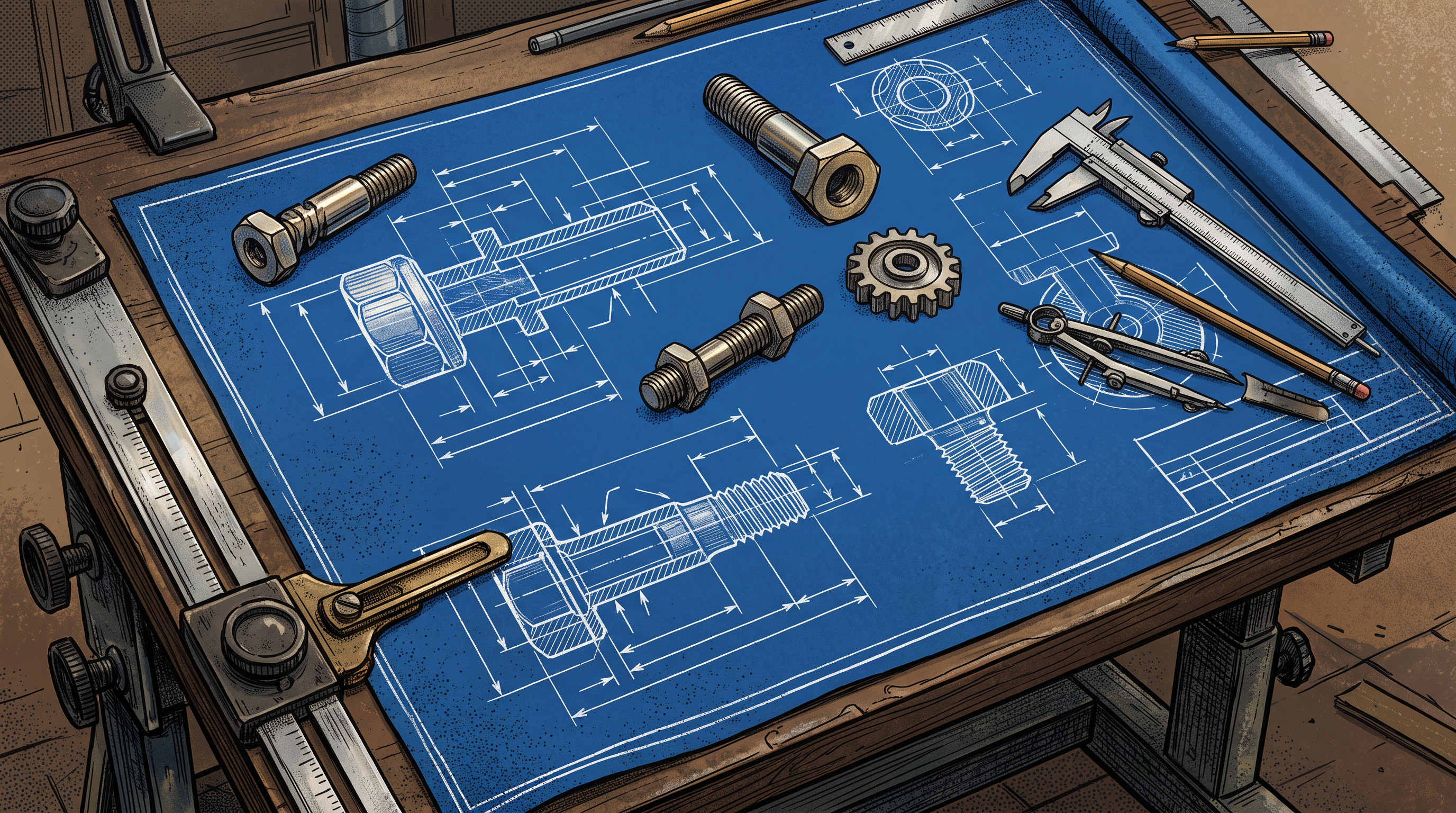
When an application demands completely unique geometry, engineers must provide fully detailed engineering drawings. Clear documentation minimizes ambiguities during feasibility reviews and quoting. A complete drawing submission must include:
- Dimensional geometry and units: Explicit linear, radial, and angular measurements, with defined units (metric or imperial).
- Tolerance callouts: General assembly tolerances alongside critical fit tolerances for bearing surfaces, thread diameters, and shank steps.
- Revision control: Clearly marked drawing revision numbers and dates to prevent mismatched design iterations.
- Thread data: Thread pitch, tolerance class, and defined runout or undercut geometry.
- Material and property class: Precise alloy definitions or mechanical grade designations.
- Surface treatment: Defined plating, passivation, or coating specifications.
- Packaging and quantity requirements: Bulk packing, batch bagging, or specific labeling constraints.
Material Selection and Property Classes
A fastener's geometry dictates fit, but its material specification determines whether it will survive operating stresses, corrosive media, and temperature variations. A common specification pitfall is relying solely on dimensional standards to convey strength. Dimensional standards do not fix the material, property class, or coating on their own.
Fasteners and customized variants are commonly produced from several core alloy categories:
- Carbon and alloy steels: Frequently specified for cold-forging and high-tensile applications. For example, cold-heading quality steels like SWRCH 6R are utilized for zinc-plated hex head bolt variants, while medium carbon and alloy steels are heat-treated to achieve required mechanical property classes.
- Austenitic stainless steels: Grades such as SUS304 / A2-70 provide baseline corrosion resistance in chemical, marine, and food-processing environments without requiring supplemental electroplated finishes.
For custom components subjected to dynamic loads, structural anchoring, or lifting, designers must evaluate mechanical performance parameters. General catalogue tables do not provide load ratings or structural installation design. When developing custom anchoring or tension components, buyers should outline the intended operating environment, load directions, and installation constraints for engineering review.
The Limits of Cross-Standard Equivalence
When tailoring fasteners from standardized baselines—such as DIN, ISO, GB/T, JIS, or ASME/ANSI families—it is critical to recognize that international reference standards are not interchangeable by name alone. Even when standard numbers appear parallel across engineering drawings, subtle dimensional discrepancies exist between standard editions.
For instance, hexagon nuts defined under DIN 934, ISO 4032:2023, and GB/T 6170-2015 feature distinct width-across-flats and nominal height tolerances across several common metric diameters. Similarly, fully threaded hex bolts under DIN 933, ISO 4017:2022, and GB/T 5783-2025 exhibit dimensional distinctions depending on the applicable revision year. Specifying custom modifications requires referencing the exact standard edition and reviewing all relevant dimensional tables rather than assuming identical geometry.
Evaluation and Production Feasibility
Transitioning from a drawing to physical manufacturing requires evaluating multiple technical criteria to determine production pathways. During the initial review, engineers assess the following stages:
- Feasibility review: Verifying that the proposed radii, wall thicknesses, head-to-shank transitions, and draft angles can be formed or machined within tolerance.
- Tooling and tooling wear: Evaluating existing die sets or establishing whether custom tooling (heading dies, trimming dies, thread-rolling dies) must be built.
- Sample verification: Producing initial prototypes or sample runs to verify dimensional conformance, mechanical properties, and coating adhesion prior to full-scale manufacturing.
- Inspection criteria: Aligning measurement methods, optical sorting requirements, and sampling plans to ensure consistent quality control.
Preparing an Inquiry for Custom Production
To obtain an accurate quotation and clear delivery assessment, procurement teams should assemble a consolidated RFQ containing the full scope of manufacturing requirements. An inquiry that omits packaging requirements, grade designations, or surface finishes leads to avoidable technical delays.
At PENLY TH CO., LTD., industrial buyers can initiate custom fastener inquiries using either a detailed drawing or by identifying an existing product family from the 75 catalogue product families across nine categories—including bolts and threaded rods, nuts, machine screws, set screws, self-drilling screws, tapping screws, washers, retaining rings, and anchors and fixings. Buyers can specify what parameters need to change relative to reference geometries.
Procurement teams can assemble unified inquiry lists covering standard and custom requirements directly through the website, and consult with the sales engineering team via Thailand WhatsApp or LINE accounts to coordinate technical drawing reviews.